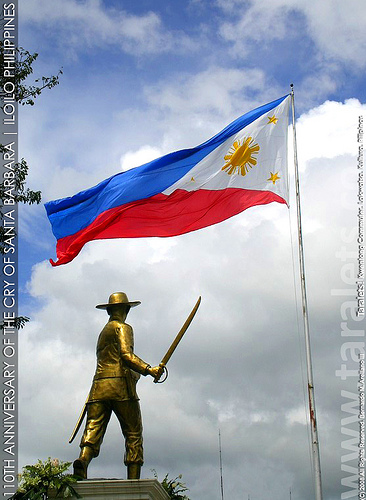
In the conventional history text books, they would mentioned that when Aguinaldo declared Independence, all of the islands have been independent from the Spanish colonizers. They were dead wrong. After that mock battle between the Americans and the Spaniards in August 1898, the latter transfered their power at Iloilo to make last reforms but they were too late.
Given that the Ilonggos were loyal to the Spanish crown (as manifested by thge city of Iloilo’s seal “La Muy Leal y Noble Ciudad”), the Spaniards stayed here thinking that they will be confident with the company of one of the most loyal peoples to them, they were wrong.
Sometime in late October, an event in Jelucuon (now part of New Lucena town) lead to the spark of the Ilonggo Revolt against the colonizers. Later on November, they moved to the town of Santa Barbara in which Nazaria Lagos “smuggled” the Philippine flag beneath the haystack. Santa Barbara was the first place outside Luzon to have hoisted the Philippine flag. The downfall of the European power is inevitable.
The story of freedom and nationality is being celebrated 109 years after its declaration in Santa Barbara with their Annual Kahilwayan Festival which is held every November 17th. Kahilwayan is the Hiligaynon word for “freedom”. The town has brought in their best dramatic interpretative dance tribes, manifesting their graceful moves and the drama behind their ancestor’s fight for freedom. This year though, the Santa Barbaranhons celebrated with 3 band-contingent competition reliving the “Marcha Independencia” which was played during the freedom march from Santa Barbara to Iloilo City, a century ago.
As the largest flag in the VisMin area was hoisted, so are the spirits of every Ilonggo, remembering what their ancestors did to attain such freedom that we enjoy now.
For more pictures of the Kahilwayan Festival, click the phrase below:
Kahilwayan Festival (Santa Barbara, Iloilo)


This is about the country’s flag and the town of Santa Barbara, Iloilo.
On March 25, 1936, President Manuel L. Quezon. Issued E.O. No. 23 prescribing the technical description and specification of the Filipino Flag. It was followed by other directives assigning the National Historical Institute as the authority in Philippine Vexillaries and Heraldry.
Gordon’s proposed bill adding yet another ray to the Philippine flag should concern all Filipinos but most especially us Ilonggos.
The eight rays within the white triangle represent the towns within Luzon that fathered the Philippine Revolution.
However, Santa Barbara, which actively participated under General Delgado, was never represented in the flag.
Gordon and even Puentebella maintain that Muslim resistance to colonial rule merits a ray. Problem is, Mindanao is already one of three stars that mark our flag.
Whatever for is this bill? It begs a timely answer- acknowledge the ” Cry of Santa Barbara” in it’s proper context.
Omon Maravilla
Oct 3, 2009
Thanks for the info Omon. Why? Is the Cry of Santa Barbara have another misconception in history? The difficulty of grassroots/local historiography in the Philippines is that it’s all about Manila and the Tagalog-centric perspective. I don’t know if I can say a lot but most of the textbooks have only mentioned about OTHER areas of the country by passing. Sometimes to the point of neglect after all…which would really not clearly visualize what this country is all about.
Yet the good news about Ilonggo local historiography is that a lot of things are yet to be explored.