
Panagbenga Festival: Two Decades of Blooming Baguio
Little Otek and his family woke up very early and went downtown that cool February day. The sun hasn’t risen yet at the pine-covered hills of the hill station in the Cordilleras. Though sleepy, he was excited to head downtown.
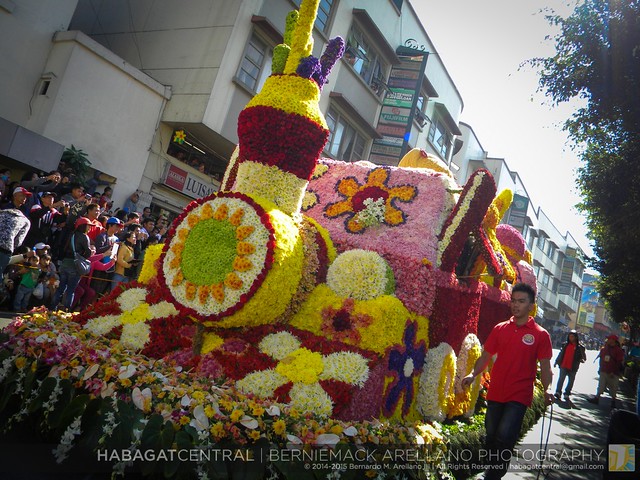
One of the flower floats of Panagbenga
“Ma, bakit kelangan nating maaga? Wala pang araw po ah!” asked Otek to her mother.
His mother replied, “Kasi baka mawalan tayo ng magandang pwesto anak.”
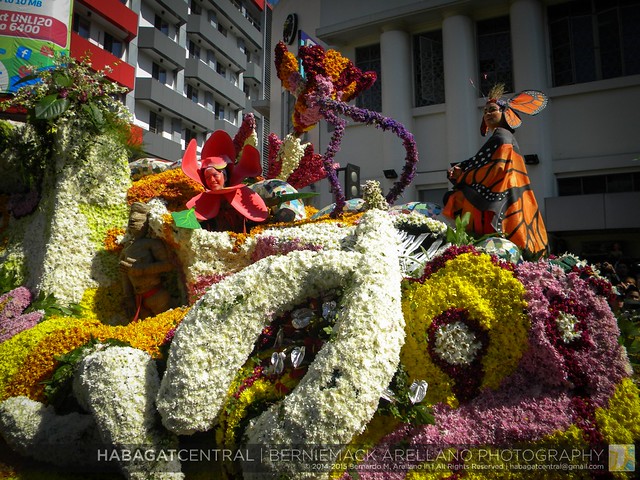
One of the colourful floats in the festival
The jeepney halted near the bus station; from there they have to walk together with thousands of people meeting up in the downtown, just like the old dap-ay of the olden days.
“Manonood nananman kami ng float and parade!” said Otek.
Thousands of people line up the main road of the hill station called Session Road. They sat at the street gutter and waited patiently until the sun shone and warmed up the morning a bit.
People lining up Session Road to watch the flowery floats of #Panagbenga2015 #Travel #Philippines #festivals A photo posted by Berniemack Arellano (@habagatcentral) on
“Buti na lang maaga kami! Nasa harapan tayo ngayon,” said Otek’s mother.
It is time of the year again when Otek and thousands of tourists converge in the hill city of the Cordilleras of Baguio, when thousands of flowers, colours, and the beat of drum, lyre, and gangsa fill the air. It’s Panagbenga season once again.
A Birth of a Baguio Tradition
Perhaps one of the most highly anticipated major festivals in the country is Baguio City’s Panagbenga Festival. Held annually every February, it is the time when thousands of tourists climb up to the “Summer Capital of the Philippines” to witness a parade of blooming flowers, creativity, and Cordilleran culture. Twenty years since its inception, the revelry has evolved from a simple festivity to one of the city’s largest crowd drawer.
It is said that like Bacolod’s MassKara Festival, Panagbenga’s roots were rooted both tragedy and celebrating nature, life, and culture. It was only a few years after the great quake that killed many locals and devastated its economy and infrastructure. The local business sector would like to perk up Baguio’s tourism economy once again, celebrate life, and somehow commemorate those who have departed with a bloom of flowers in this city.
“Di ka pa pinapanganak noon nung halos parang nagiba ang Baguio. Ang hirap noon,” told Otek’s mother to his son.
In 1995, the Baguio’s local business and political leaders brought the idea of Baguio having its own flower festival. The festivity focuses on the Cordilleran traditions, beliefs, and even its natural resources.
“Yung Panagbenga dati, simple lang. Nung studyante pa lang ako sumayaw din kami sa parada kasama ng mga matatanda. Tas simple lang noon ang dekorasyon ng mga bulaklak, anak,” she reminisced.
“Ma, bakit pala Panagbenga tawag sa festival? Ano poi big sabihin ‘nun?” Otek asked.
“Yung salitang ‘Panagbenga’ anak, ibig sabihin nyan ‘panahon ng tagsibol ng mga bulaklak’ sa mga Kankana-ey.” (Son, the word “Panagbenga” came from the Kankana-ey word that meant “season of bloom” or “time of flowering.”)
That’s why there are flower floats, flower decorations, and flower-inspired parade, she added.
The family watched the parade as floats pass by Session Road. Photographers were abuzz with taking the best angles. The marshals were guarding. The people raised their hands together with their smartphones, iPhones, digital cameras, or tablets as if they were giving praise to the flower floats and the contingents.
More so, when a familiar celebrity is alight one of the floats, the scream of people in the downtown is like a wave of excitement and anticipation cascading downhill. Some would even joke, “may artista jan!” and people started screaming with glee.
That Familiar Panagbenga Beat
As the parade continues, this familiar beat keeps on playing on every drum, bugle, and lyre contingents the whole month.
“Ayan na ang LSS of the month ko,” said Otek’s older sister.
Though it sounds modern, the late Professor Macario Fronda of Saint Louis University composed the Panagbenga theme, which driven its inspiration from the Bendian dance, an Ibaloi dance ritual of celebration of unity—which emphasizes the unity of the people of Baguio and the Cordilleran peoples.
Here’s a video of a Bendian dance in Benguet
May mas malalim pa na hugot pala ang napakapamilyar na nakaka-LSS na Panagbenga beat.
Heading Home
By noontime, the parade was over. While some headed to the Academic Oval to watch, others went to shop at Burnham Park for some souvenirs. Session Road and the narrow roads of Baguio were so full of people, that it feels like the lowland temperatures have been reached.
In fact, Panagbenga’s crowd is said to be notorious for being so jampacked, city-wide vehicular traffic, and pickpockets—like any other festivities in the world. These didn’t hinder Otek’s family to witness and experience the annual revelry.
“Till next time,” said Otek, as his family heads home for some kiniing, papaitan, and pinikpikan for lunch.
As for Baguio, hope blooms.