
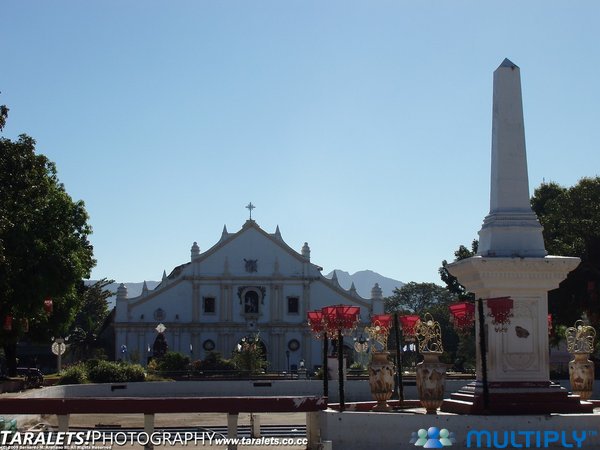
Plaza Salcedo & Vigan Cathedral, Vigan City, Ilocos Sur
The plaza or town square has been the core of every Spanish colonial settlement in the Philippines. The plaza can be a venue of anything, from carnivals, fairs to public execution. Surrounding it are mostly important edifices of local authority. The heritage city of Vigan, the capital of Ilocos Sur, has one of the finest classical examples of the plaza complex…a heritage of urban planning in the Philippines.
Plaza Salcedo
Plaza Salcedo and Ilocos Sur Provincial Capitol, Vigan City, Ilocos Sur, Philippines
Perhaps, the first glimpse of Vigan would probably be at Plaza Salcedo and several imposing yet important edifices that surround the spacious plaza. The Plaza itself was named after the Spanish conquistador Juan de Salcedo, who explored the northern part of Luzon island, todo en nombre de España (all in the name of Spain) in the late 16th century.
It is in this area where you can find the ecclesiastical, the provincial and the city authorities…all in one area. Indeed, this is Ciudad Fernandina’s seat of power. This plaza does not only have the usual monuments and trees, but also have a towering obelisk in the middle of a reflecting pool! (Too bad the pool was dried up for cleaning when we went there).
Monument at Plaza Salcedo, Vigan City, Ilocos Sur, Philippines
Today, together with the edifices of power comes the edifices of commerce…Mart One and Plaza Maestro, both shopping areas in Vigan, still utilized the predominant bahay na bato and baroque architecture to adapt in its surroundings. Even Jolibee and McDonalds nearby has also the same motif!
From this point on, you can go anywhere in Vigan City…to its commercial district along Quezon Avenue, to the picture-and-movie-perfect heritage houses along Calle Crisologo. Truly, Plaza Salcedo is the core of the Heritage City of Vigan.
Vigan Cathedral
Vigan Cathedral and Belfry
Saint Paul Metropolitan Cathedral or much known as Vigan Cathedral is a baroque church basked in cream and white stands at the eastern edge of the plaza. A wooden church was erected here in 1574 by the command of the conquistador Juan de Salcedo. The present stone church was built in 1641 and became a cathedral when the Archdiocesan seat of power of Nueva Segovia transferred from modern-day Lal-lo in Cagayan province to Villa Fernandina or Vigan in 1758. The church became a bastion of Filipino revolutionaries under Colonel Juan Villamor in 1896 and by the American colonial troops under Lieutenant Colonel James Parker in 1899. The interior of the cathedral is well lit with a tone of classical beige and cream. The retablo is rather simple compared to some of its counterparts, yet eloquent as most baroque altars are.
Vigan Cathedral Belfry
And because of the constant threat of earthquakes that rattle Ilocandia, the friars that designed the cathedral has had the belfry separated from the main church itself. Some say, this is to prevent excessive damage to the church during earthquakes since most of the time, the campanarios or belfries fall first during a trembler.
Inside Vigan Cathedral
Today, the cathedral is a venue for the religious devotion of Ilocano and Filipino Catholics. I heard that the Holy Week here is a must see for all who love antiquity and culture.
Arzobispado de Nueva Segovia
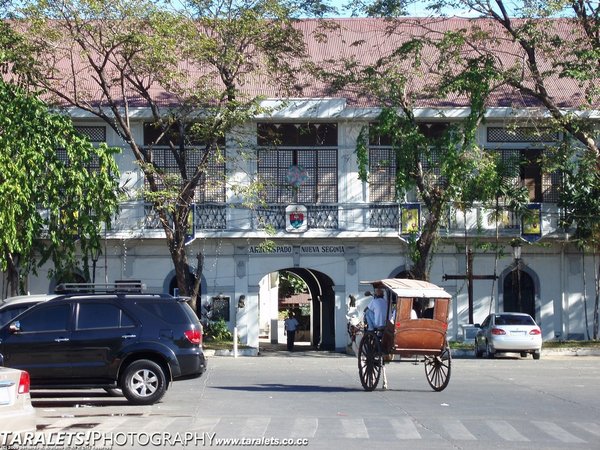
Arzobispado de Nueva Segovia
Also known as the Archbishop’s Palace of Nueva Segovia, this is the seat of power and the official residence of the archbishop of Nueva Segovia…which holds authority to most of present day parishes all throughout Ilocandia and some parts of Cordillera. The diocese of Nueva Segovia was made through the Papal Bull of Pope Clement VIII and the efforts of Bishop Domingo de Salazar in Madrid in 1595. Fray Miguel de Benavides OSA became its first bishop…and as I’ve said earlier, the first site was at Lal-lo in Cagayan.
Chinese Foo Dogs at the Side of the Main Doorway of the Archbishop's Palace in Vigan
The current archbishop’s palace, a classical example of Spanish colonial architecture, was built in 1783 to 1790…yes folks its more than 200 years old and it’s still standing! It has witnessed the occupation of the revolucionarios in 1896 and the American occupation in 1899. The Ecclesiastical Court was once located here until 1890.
The Archbishop's Palace and Manong Sorbetero
By the way, if you have the eye for detail…you might be wondering why there are Chinese foo dogs at the side of the main doorway? Like San Agustin Church in Intramuros Manila, Cebu Cathedral and many more, most probable explanation would be the employment of Chinese laborers during the construction of the edifice. And please correct me if I’m wrong but the Chinese believe that foo dogs are guardians of the house.
Ilocos Sur Capitol and City Hall of Vigan
(Note: Tell me if you’re nose-bleeding or bored, hehe!)
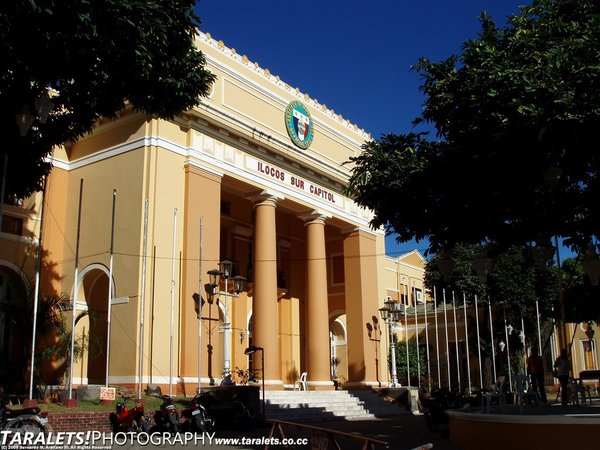
Provincial Capitol of Ilocos Sur, Vigan City, Ilocos Sur, Philippines
Like all plaza complexes in the country, state power is also located besides the plaza. On the western side of the plaza…opposite of the majestic Vigan Cathedral, is the Provincial Capitol of Ilocos Sur. The capitol was built during the American Occupation in the Philippines. While much of Vigan is under Don Quixote’s influence in terms of architecture, the capitol was influenced by Uncle Sam’s frenzy over neo-classical buildings like those seen in Washington DC and even in the newer government buildings in Manila during that time. The capitol’s façade is dominated by its two Doric columns…and by the time we went there, they painted it in warm pastel earth colors…a reflection of the Ilocano’s colour of culture, of hard work and resourcefulness.
City Hall of Vigan, Ilocos Sur, Philippines
While the provincial capitol of Ilocos Sur belongs to the league of neo-classical provincial capitols in the country, the City Hall of Vigan is somehow reminiscent of the old presidencias or municipal halls during the Spanish colonial period. Basked in blue, it is the seat of city government of Vigan.
View Larger Map
More photos of Plaza Salcedo, Vigan Cathedral, Provincial Capitol, City Hall of Vigan and the surrounding buildings of the Plaza here:





Pingback: Vigan on a Calesa Tour | HabagatCentral.com