
Visita Iglesia: Basilica Minore de Santo Niño de Cebú

Basilica Minore de Santo Nino de Cebu
While traditionally it has been seven Catholic Churches that has to be visited during the Visita Iglesia on Holy Week, I’ll be featuring only two…yet these are the closest to both my heart and soul. The first one would be the Philippines’ first Catholic Church, a pilgrimage site, a historic site, and a bastion of devotion for millions—Basilica Minore de Santo Niño de Cebu.
Located at the heart of the oldest European-established settlement in the Philippines, the Basilica Minore de Santo Niño is “a must visit” church in Cebu City, which is just beside its iconic monument, the kiosk of Magellan’s Cross. Its importance to Cebuano culture and Philippine history is simply undeniable, as it houses the oldest European religious relic in the country, and the focal point of devotion of millions—the Santo Niño de Cebu or the Holy Child.
A family venerates the Christ Child. This is the oldest European relic in the entire Philippine Islands. The same image was said to be the one given to Queen Juana of Cebu by explorer Ferdinand Magellan in 1521, and was rediscovered 40 years later by Miguel Lopez de Legazpi’s men.
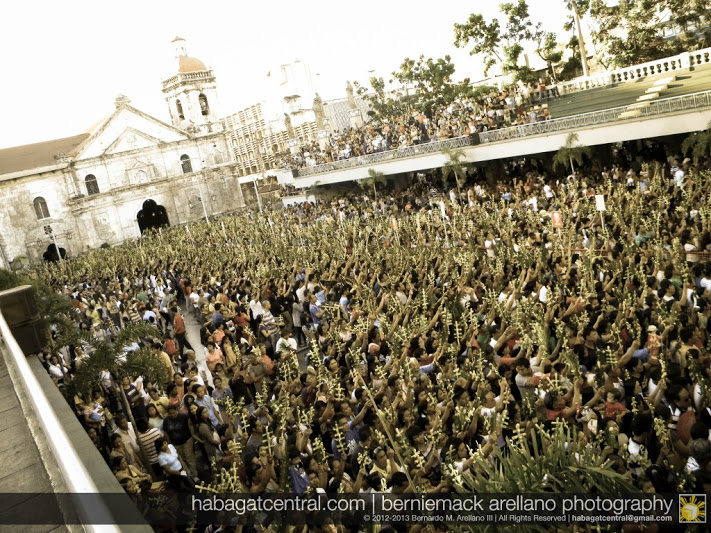
Basilica on a Palm Sunday
It was once known as the Church of San Agustin, since the Order of Saint Augustine are the ones who established and manages the church.
Fray Andres Urdaneta, OSA established the convent in 1566 as a simple church made of nipa and light materials “on the same spot that they found the Santo Niño,” when Miguel Lopez de Legazpi conquered ancient Sugbo. The image of the Holy Child was given 40 years ago by Ferdinand Magellan to Queen Juana of Cebu. The image’s survival (and was said to be adored by ancient Sugboanons themselves when it was found in a box full of flowers) was believed to be a sign of a miracle for the conquistadors.
The Hapsburg Eagle inside the Agustinian Library of the Basilica (2007)
The church was rebuilt several times after it got burned or some defect was seen, until in 1735 when Father Juan de Albarran, the prior of Santo Niño, and together with other priests in Cebu and the people, built the present stone church that we are seeing now. I was surprised at the origins of the Basilica’s stones. According to the church’s website,
“The stones were quarried from Capiz and Panay by an army of bancas. The molave wood came from the mountains of Talisay and Pitalo and was transported in bancas hired in Argao and Carcar. Fr. Albarran confessed that there was much difficulty in quarrying the stones. Despite the seemingly impossible task, Fr. Albarran was not discouraged. He used white stones to make the lime, with one banca transporting some 400 pieces of stones.”
The stones used to build this Basilica came all the way from Panay Island and Capiz, according to its official website.
Wow! No wonder. Somehow, the foundation of this great church has hometown significance not many know. Four years later, the church and the convent was finished.
Here’s the performance of Sinulog-based champion, Sinanduloy Cultural Dance Troupe depicting the building of the Basilica.
While this is not Cebu’s ecclesiastical seat, the Basilica holds resemblance and significance for the Cebuanos and Filipinos alike. Thousands of visitors, may it be devotees, tourists, or parishioners, visit the place—even when there are no Mass. Take a picture of the historic place, pray silently in its halls, light a candle, or visiting the Holy Child itself…the basilica is a myriad of scenes, sometimes surreal.
The Basilica’s Museum, located just behind the Pilgrim Center
There are two peculiar characteristics that is noticeable in the Basilica Minore de Santo Niño:
- The dancing ladies in front of the church, waving their candles and citing prayers and end it up with “Viva Pit Senyor!”—the core basis of one of Philippines’ grandest festivals, Sinulog Festival. The ritual the ladies are doing is the sinulog.
- Balloons, balloons everywhere! There is a belief that these balloons carry the prayers of the petitioners to the heavens.
Balloons sold inside the Basilica. Tradition has it that a petitioner’s prayer is carried by the balloon up in the heavens.
And as for me, the Basilica is considered my two most personal spiritual sanctuaries. Even though I may call myself a nominal Catholic (not your very devout one), there is something here wherein I can find my peace of mind or tranquility amid the sea of people everywhere. I had my close encounter with the Santo Niño itself inside the library of the Agustinians, several years ago. I do my regular Mass here every Sundays, whenever I am in Cebu (and eversince I moved back to Cebu). Whatever logic tries to explain, it simply doesn’t answer, hence I put my faith in a “life force” that makes me come back almost every time.
The Basilica Minore de Santo Niño de Cebu for me, is both an important socio-cultural icon, and a personal “spiritual” center.
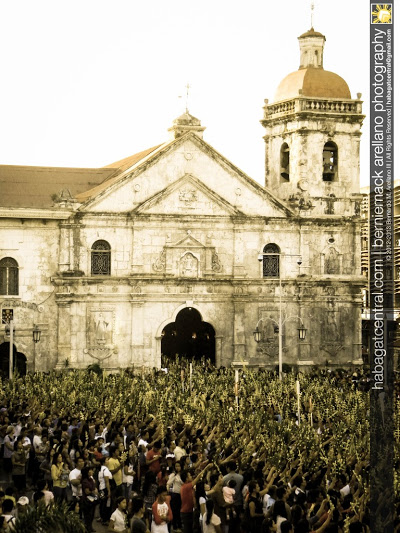
The multitude
How to Get to Basilica Minore del Santo Niño:
Being at the heart of downtown Cebu City, going to the church is not that as difficult as most jeepneys pass by or near the church. Just look for a sign or the barker-conductor screaming “Sto. Niño!” You won’t miss it.
View Larger Map
