
Tugaya: Obra Maestra Maranao Primera
The debekan/dadabuan carvings
A lot of people have been to Lanao Del Sur, but they are just either at MSU or Marawi City itself. They never dared explore the towns beside the placid Lake Lanao for so many concerns and reasons. However, I was allured by the town of Tugaya in some journals and websites I read. It is said to be the bastion of arts and craft of the Maranao people. Curiously, it is a town full of talented craftsmen that is famed all throughout Mindanao for its fine products, may it be brass ware to clothing and tapestry, which has been handed over from their ancestors for centuries. Because of it’s fame, it was even nominated by the National Center for Culture and the Arts for UNESCO World Heritage List in early 2000s. Now, it made me more curious—hence it became my primary goal in visiting Tugaya.
The "placid" Tugaya town in Lanao Lake's shore
Tugaya is a 30-45 minute drive from Marawi City, along the western side of the lake shore. Traversing the slopes and more Maranao communities, Lanao’s landscape is dotted with so many mosques, a highway that is as narrow as a barangay road in some of the provinces, and surreal captions. It is indeed a different world out here, yet so within the Republic of the Philippines. This is Lanao that most tourists wouldn’t even dare to travel.
Modern Torogan in Tugaya
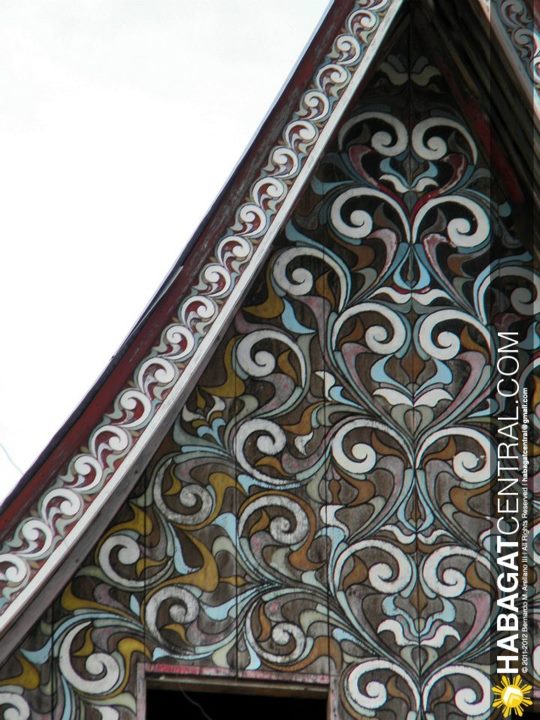
Details of the relief of the torogan-inspired house
It was almost 12 noon when we reached Tugaya along with our Maranao guides. Our first visit was a house with ornate reliefs, okirs and the steep yet curving roof that resonate the traditional torogan. Modern as the house may be, but the owners of the said house have still incorporated the traditional Maranao craft. Kala ko sa Nayong Pilipino at sa mga airports sa Mindanao makikita mga yan.
Dilimbayan Central Mosque
Since it was noon time, the muezzin was calling the faithful for prayer at the town’s largest mosque—Dilimbayan Central Mosque.
Baul - A wooden box
Detail of baul with inlays of mother-of-pearl shells
Just beside the mosque, the family of our hosts was also involved in arts and craft, by creating baul or ornate wooden boxes with ornate carved designs and adorned with pieces of mother-of-pearl shells. These were made of hard wood—hence despite its simplicity, is still very expensive. Often, the Maranaos and the antique collectors from Davao or Manila buy these boxes.
Unfinished product of baul
Another treasure that was well hidden by the hosts’ family was the galleon boat models, carved out from wood. Done perfectly and kept as a treasure by the family.
The galleon, hidden from public view
Details of the galleon
The sails are made of coconut shells
Of course, another one of Tugaya’s products is the dadabuan or the tall wooden and carved drums. The dadabuan was used to summon the people of an impending danger or a meeting or celebrations. The top of the dadabuan uses animal skin (goat or cow skin) the rest of the drum is carved out with the intricate Maranao carvings. The wood they usually use are from the jackfruit or mango tree, giving it a yellowish colour.
Making dadabuan in a workshop at Tugaya
The intricate carvings of dadabuan
One of the small finished dadabuans
I’m not done yet for Tugaya. There are still a lot more from this placid town by the lake shore.


-
emilyazalea